In this guide
Choosing toys that align with a child’s growing abilities can support early literacy, numeracy, fine motor skills, and social play. This guide highlights five carefully selected toys designed to engage preschoolers ages 3 to 5 while fostering curiosity, problem solving, and independent exploration. Each option emphasizes safe materials, hands-on learning, and age-appropriate challenges to support long-term development.
| Product | Brand | Key Benefit |
|---|---|---|
| Magnetic Wooden Fishing Game Toy for Toddlers | NASHRIO | Letter and number recognition with a wooden, eco-friendly design |
| Montessori Educational Learning Toys | Gagule | Hands-on counting and basic math concepts |
| Toddler Magnetic Blocks Building Toys | BigShu | Fine motor skills, counting, color and shape recognition |
| MTYOKILN Magnetic Color & Number Maze | MTYOKILN | Color matching, number awareness, and dexterity |
| Preschool Learning Activities Workbook | Walenty | Tracing, handwriting, and early literacy skills |
Magnetic Wooden Fishing Game Toy For Toddlers
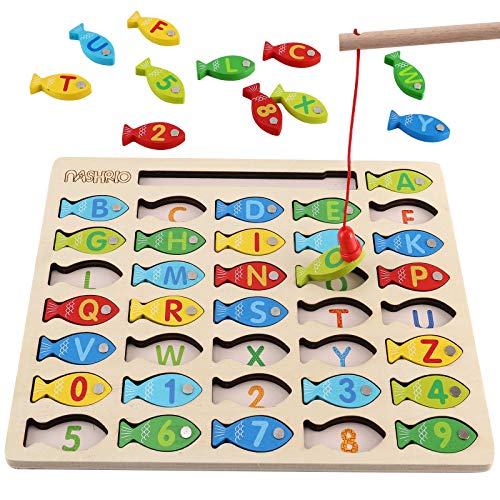
The Magnetic Wooden Fishing Game Toy offers a colorful board with numerous fish pieces labeled with letters and numbers. Children use a magnetic fishing pole to catch fish, which supports early literacy and numeracy while encouraging hand-eye coordination. The wooden construction features smooth edges and water-based dyes, providing a durable, non-toxic option for everyday play. This toy is designed to engage children ages 3 and up through interactive, sequential play that reinforces color, letter, and number differentiation.
HopeRock Frog Game With Modes And Lights

This multi-mode action toy brings tactile and auditory feedback through tapping sparkly, light-up frogs and a spray function. With five modes and 45 levels, children practice timing, fine motor control, and rhythm in a cooperative or solo setting. The game’s upgraded spray feature adds an extra layer of engagement, stimulating visual tracking and language-related cues as children describe what they see and do. Recommended for children around 3 years and older, the toy supports growing coordination and memory skills through play.
Montessori Educational Learning Toys For 3-5

Designed to engage little hands and curious minds, this kit combines a wooden finger counting board, number counting blocks, and math flash cards. It emphasizes visual and tactile learning to support early numeracy, addition, and subtraction within 10. Suitable for homeschooling and preschool settings, the set aids in building fine motor skills while fostering independent exploration and problem-solving in a Montessori-inspired framework.
MTYOKILN Magnetic Color & Number Maze

The MTYOKILN Magnetic Color & Number Maze places magnetic beads along a track to form ice-creams representing numbers 1-10. Children practice color recognition, counting, and careful manipulation of magnetic pieces. This Montessori-aligned activity encourages precision and focus, with a simple premise that scales in difficulty as kids improve. It’s a compact option suitable for travel and classroom use, fostering patience and manual dexterity in early learners aged 3 to 5.
Preschool Learning Activities Workbook

This workbook focuses on tracing, handwriting practice, color and shape recognition, and basic math tasks. With durable, erasable pages and dry-erase markers, it supports repeated practice for 3- to 5-year-olds. The structured activities help develop concentration, fine motor control, and early literacy skills in a portable, reusable format, making it suitable for homeschoolers, preschoolers, and busy households seeking a tangible learning companion.
Buying Guide
Key purchase considerations for developmentally appropriate toys for 3- to 5-year-olds include safety, educational value, and the capacity to scale with a child’s growing abilities. Look for non-toxic materials, rounded edges, and sturdy construction for durability and safety. Toys that combine multiple skills—such as motor control, color or number recognition, and problem-solving—toster a well-rounded developmental experience. Consider the child’s interests and the family’s routine to determine whether solo play or collaborative activities (like family game sessions) are more suitable. Finally, assess how a toy can transition into new challenges as the child grows, ensuring ongoing engagement without overwhelming the learner.
For a well-rounded choice, the selected products above provide varied approaches: hands-on manipulation with letters and numbers (NASHRIO); Montessori-inspired counting and math practice (Gagule); magnetic construction to foster spatial reasoning (BigShu); color-number matching with a maze format (MTYOKILN); and reusable handwriting and tracing practice (Walenty). Each option supports cognitive, motor, and social development with age-appropriate challenges and safe materials.