In this guide
Exploring electricity at a young age builds curiosity and critical thinking. The following product picks offer hands-on experiments, clear instructions, and safe components designed for kids aged 8 and up. Each option supports STEM learning through engaging activities that demonstrate circuits, power, and basic electronics.
style=”font-weight:bold;”>Selected Products Summary
| Product | Brand |
|---|---|
| Blue Marble National Geographic Circuit Maker Kit – 120 Projects | Blue Marble |
| Doctor Jupiter Ultimate Science Gift Set | Doctor Jupiter |
| NATIONAL GEOGRAPHIC Circuit Maker Kit – 60 Projects | Blue Marble |
| Science Circuit Kit Electricity for Kids | GadgetGlee |
| Sntieecr Electric Circuit Motor Kit | Sntieecr |
Blue Marble National Geographic Circuit Maker Kit

The Blue Marble National Geographic Circuit Maker Kit contains over 120 projects that introduce kids to electricity fundamentals through interactive activities. Projects range from building simple circuits to creating sound systems, light shows, and even miniature copters. The kit emphasizes safety with kid-friendly components and illustrated instructions, plus a QR code linking to video guides for clearer demonstrations. It’s designed to keep learners engaged while reinforcing core concepts about circuits, power sources, and energy transfer.
Doctor Jupiter Ultimate Science Gift Set

This gift set targets children aged 8 to 14, offering a curated mix of science experiments with a focus on electricity, water science, and other STEM topics. The activities are designed for screen-free learning and aim to build critical thinking, problem-solving, and hands-on discovery skills. Parents can expect a structured, enjoyable path through various experiments that demonstrate electrical principles alongside broader scientific inquiry.
NATIONAL GEOGRAPHIC Circuit Maker Kit — 60 Projects

This National Geographic kit provides more than 60 circuit projects, including fiber optic lighting, levitation demonstrations, and flying a copter. Video-guided, kid-friendly instructions accompany the components to ensure safe, independent exploration of how electricity flows and how circuits are constructed. It emphasizes creativity alongside foundational electrical concepts, suitable for curious learners who enjoy visual, hands-on activities.
Science Circuit Kit Electricity for Kids by GadgetGlee

GadgetGlee’s Science Circuit Kit offers eight circuit experiments packed into seven packs, with an illustrated circuit book for guided learning. It targets foundational topics like series and parallel circuits, energy generation, and practical applications such as fruit and saltwater power experiments. The kit is designed to support structured learning while encouraging experimentation and critical thinking about how circuits influence real-world devices.
Sntieecr Electric Circuit Motor Kit
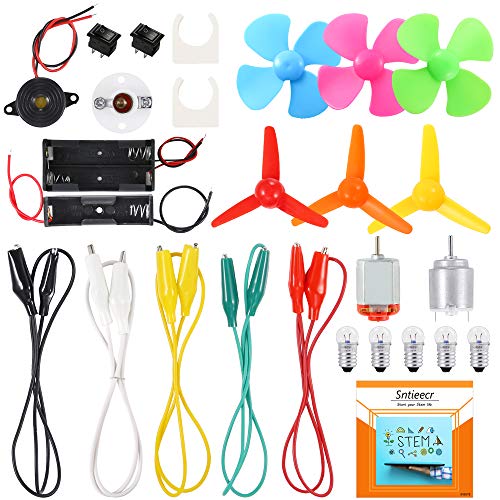
The Sntieecr kit provides a comprehensive set of circuit components for building basic electrical circuits and motor-driven projects. It includes multiple motors, switches, bulbs, and a battery holder to facilitate a range of experiments—from simple circuits to more complex motor-powered designs. The set is well-suited for school science projects and home learning sessions that emphasize practical assembly and experimentation with electrical systems.
Buying Guide: Key Considerations For Choosing Kids’ Electricity Kits
- Age and safety: Look for kits with age-appropriate components and clearly labeled safety guidelines. Non-toxic, sturdy parts and shatterproof containers are ideal for younger children.
- Project variety: Choose kits that offer a mix of projects—ranging from basic circuits to more advanced experiments—to maintain engagement as skills grow.
- Instruction quality: Visual guides and QR code video tutorials help kids follow steps confidently. A well-illustrated circuit book can reinforce concepts at their own pace.
- Hands-on learning: Kits should provide a balance of building, testing, and documenting results, fostering critical thinking and problem-solving.
- Expandability: Consider components and accessories that can be used with other kits to extend learning beyond the initial projects.
- Real-world relevance: Projects that demonstrate everyday electricity applications (lights, sensors, motors) help kids connect theory to everyday devices.
- Storage and organization: A sturdy storage box or tray system keeps parts organized, reducing loss and encouraging ongoing experimentation.
- Value and longevity: Higher-project-count kits may offer greater long-term learning, but ensure the content remains age-appropriate and safe.
- Gender-neutral design: Seek kits that emphasize curiosity and exploration over stereotypes, inviting any child to explore STEM topics.
- Supplementary tools: Some kits include measurement tools or multimeters; evaluate whether additional tools are needed or included.