In this guide
Finding an effective learning clock for toddlers blends play with skill-building. The best options combine clear hour and minute cues, interactive features, and gentle wake-time or bedtime functions to support early time-telling skills. The selected products below emphasize hands-on learning, kid-friendly design, and classroom- or home-friendly use. Use these as reference points to compare styles, sounds, and durability while helping your child gain confidence with analog and digital time concepts.
| Product | Brand | Key Benefit | Link |
|---|---|---|---|
| BEST LEARNING Learning Clock | BEST LEARNING | Award-winning interactive clock with quiz mode and Sleep Mode | View |
| Oyster&Pop Learning Clock | Oyster&Pop | Silent wall clock with labeled hands and free learning e-book | View |
| Learning Resources Big Time Mini Clock | Learning Resources | Hands-on clock with hidden gears and color-coded hands | View |
| Learning Resources Tock The Learning Clock Pink | Learning Resources | Analog and digital time displays with engaging modes | View |
| V-Opitos Clock Learning | V-Opitos | Multifunction clock with travel-friendly design and diverse learning modes | View |
Note: This table highlights five strong options for toddlers learning to tell time. Each product emphasizes different learning cues—visual, auditory, or tactile—to support early time literacy and routine-building at home or in classrooms.
BEST LEARNING Learning Clock

The BEST LEARNING clock is a multi-award-winning interactive toy designed to teach children to read the time. It features an easy-to-align hour hand and a minute hand that kids adjust with a gentle touch. In Quiz Mode, the clock asks questions to reinforce time-reading concepts, keeping youngsters engaged. Sleep Mode plays classical music and functions as a night light with multiple timer options, supporting bedtime routines while reinforcing time concepts.
Oyster&Pop Learning Clock

This 10″ wall clock is designed by teachers and parents for kids. It labels minutes and quarters to simplify time reading and uses a rainbow, kid-friendly design to inspire learning. The clock is non-ticking, reducing distractions and promoting focus during study or sleep. It operates quietly with a single AA battery, and the accompanying free e-book offers additional time-telling ideas for parents and educators.
Learning Resources Big Time Mini Clock

This teaching clock emphasizes hands-on learning with hidden gears that maintain accurate time as children spin the hands. The color-coded hands align with hour and minute markings, supporting quick visual associations. The compact design makes it suitable for small-group activities or individual practice in classrooms and homes.
Learning Resources Tock The Learning Clock Pink
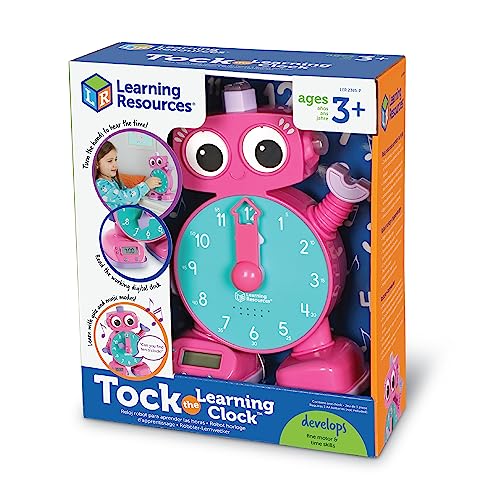
This clock blends analog and digital time displays for a comprehensive tell-time experience. It includes interactive modes such as music and quizzes to reinforce learning in a playful setting. The design is classroom-ready and suitable for homeschool environments, promoting independence as kids practice telling time through guided activities.
V-Opitos Clock Learning

The V-Opitos clock focuses on time-learning with multiple modes, including time learning, quizzes, and bilingual options. A built-in handle makes it easy to carry, supporting travel and classroom use. The clock also features light-up prompts that guide children through time-telling steps, encouraging engagement and independent practice in a tactile, portable format.
Buying Guide: Key Purchase Considerations
When choosing a learning clock for toddlers, consider how the clock supports foundational time skills and daily routines. Look for clocks with visible hour and minute indicators, intuitive controls, and engaging modes like quizzes or music that reinforce concepts without overwhelming young learners. Evaluate potential distractions (noise level, bright lights) and whether a silent or audible clock better suits your child’s learning environment. Durability and age-appropriateness matter, as younger toddlers benefit from robust, simple designs while older preschoolers may enjoy more complex features. Portability and battery life are practical factors for travel and classroom use.
Time-telling approaches vary. Some clocks emphasize manual hand-movement to teach concept mapping between positions and times, while others pair analog displays with digital readouts for cross-modal learning. Consider whether you want a clock with a Sleep or OK-To-Wake feature to support consistent routines, or one with a built-in night light for bedtime comfort. Companion resources, like free e-books or printable activities, can extend learning beyond the clock itself. Finally, compare price against features to select a long-lasting option that supports steady skill progression.
Product variety means you can tailor your choice to your child’s interests—colorful visuals, gentle sounds, and interactive challenges all play roles in keeping a child engaged. For families with multiple children or a classroom setting, you might prioritize features that promote independent practice and collaborative learning opportunities, such as quizzes that can be completed without direct supervision.