In this guide
The following selection highlights engaging, age-appropriate science toys that appeal to teens and aspiring young engineers. Each kit emphasizes hands-on learning, problem solving, and real-world tech concepts—from robotics and electronics to solar power and crystal growth. Below you’ll find five carefully chosen products with practical features that support STEM development while offering fun, screen-free activities for teens eager to explore science, technology, engineering, and math.
| Product | Brand | What It Teaches |
|---|---|---|
| ELEGOO UNO R3 Smart Robot Car Kit V4 | ELEGOO | Programming, electronics, robotics |
| 4M Crystal Growing Science Kit | 4M | Crystal growth, geology, laboratory skills |
| Sillbird 12-in-1 Solar Robot Kit | Sillbird | Solar power, engineering, DIY robotics |
| National Geographic Gross Science Kit | Blue Marble | Gross-out experiments, observation, scientific thinking |
| STEM 13-in-1 Solar Power Robots | Bottleboom | Solar energy, mechanical design, problem solving |
ELEGOO UNO R3 Smart Robot Car Kit V4

Designed for beginners and advancing students, this STEM kit introduces programming, electronics assembly, and robotics concepts. It includes 24 module parts such as obstacle avoidance and line tracing modules, with control options via Android and iOS devices. The kit’s modular design supports progressive learning, reducing the likelihood of assembly errors thanks to standardized interfaces. Aimed at teens, it provides a comprehensive platform to explore autonomous navigation, sensor integration, and mobile control, making it a versatile long-term project for classroom or at-home STEM exploration.
4M Crystal Growing Science Kit

This crystal-growing kit lets teens perform seven different experiments, using hot water and distilled liquids to grow crystals in included display cases. It blends geology and chemistry in an accessible format, with crystal specimens ready for display. The kit is suitable for curious teens who enjoy hands-on lab activities and want a tangible way to visualize crystal structures, growth rates, and the effects of temperature and solution concentration. A strong gift choice for budding scientists with an interest in geology and materials science.
Sillbird 12-in-1 Solar Robot Kit
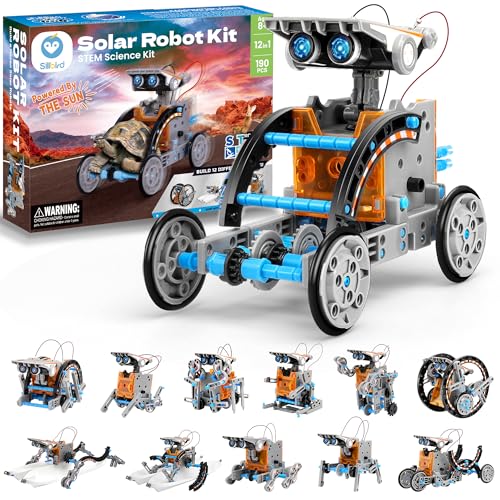
Powered by the sun, this kit provides 190 pieces to build and rebuild multiple solar-powered robots. It emphasizes outdoor exploration and renewable energy concepts, encouraging teens to experiment with engineering designs that move under solar power or indoor light. The 12-in-1 configurations support iterative learning, helping students understand mechanical relationships, gears, and the impact of power sources on movement. Ideal for hands-on, screen-free STEM play with a focus on sustainable technology.
National Geographic Gross Science Kit

National Geographic’s gross science kit brings a playful approach to biology and chemistry with 15 gross experiments and an additional 30 using common household items. Teens will explore unusual, curiosity-sparking demonstrations, from slime to quirky test-tube reactions, while the kid-friendly guide explains the science behind each effect. This kit is a memorable way to promote scientific thinking, observation, and hypothesis testing in a relaxed, engaging format.
Stem Projects Toys for Boys 8-12: DIY Bluetooth Speaker & FM Radio

This dual-project kit combines electronics assembly with audio and radio concepts. Teens build a Bluetooth speaker and a working FM radio, learning about circuits, amplifiers, and signal reception. Clear assembly instructions and a compact kit design support independent learning as well as collaborative projects, offering a hands-on path to understand how sound systems and wireless technology function.
STEM 13-in-1 Solar Power Robots

This solar-based kit allows building and transforming 13 robot designs that run on solar energy. It teaches renewable power concepts, mechanical design, and iterative engineering. The parts are made from non-toxic ABS materials, emphasizing safety while encouraging experimentation with different robot configurations. It’s well-suited for teens who want a scalable, energy-focused project with ongoing opportunities to rebuild and improve performance using solar power.
Buying Guide: Key Purchase Considerations
- Learning goals: Determine whether the teen’s interests skew toward robotics, electronics, or science experiments to pick a kit that aligns with their curiosity.
- Skill level and scalability: Look for kits with modular components or multiple project options to support progression from beginner to more advanced builds.
- Power source and environment: Solar-powered kits suit outdoor use and renewable energy learning, while electronics kits work well indoors and with batteries or USB power.
- Instruction quality: Clear, step-by-step guides and diagrams help ensure successful assembly and reduce frustration during challenging builds.
- Safety and materials: Choose non-toxic materials and age-appropriate components with safety features, especially for younger or beginner teens.
- Expansion potential: Kits that integrate with existing devices (smartphones, microcontrollers) can extend learning into programming and app control.
- Educational outcomes: Favor kits with practical explanations of the science concepts involved, not just assembly steps, to encourage deeper understanding.
- Reusability: Consider whether the kit offers multiple configurations or extra parts to maximize learning value over time.
Across these selections, teens gain practical experience in problem solving, critical thinking, and scientific communication. Families and educators can leverage these kits to create project-based learning experiences that bridge classroom concepts with real-world applications.