In this guide
Robotics kits aren’t just for kids anymore. A growing selection of STEM-focused kits is designed for teens and adults who want hands-on experience with electronics, programming, and mechanical design. This guide highlights five standout kits that blend learning with practical creativity, spanning Arduino-compatible builds, camera-enabled robots, and pneumatic or servo-driven projects. Whether you’re aiming to sharpen debugging skills, prepare for a hobbyist career, or simply enjoy engineering challenges, these kits offer structured tutorials, modular expandability, and scalable complexity.
Summary of selected products
| Product | Brand | Key Benefit | Typical Use |
|---|---|---|---|
| UNO R3 Smart Robot Car Kit V4 | ELEGOO | Hands-on Arduino robotics with multiple modules | Beginner to intermediate projects |
| Conqueror Robot Tank Kit | ELEGOO | Open resources and rich learning content | Circuit building and programming practice |
| Robot Arm Kits (ANNISOKA) | ANNISOKA | Electrical engineering with 3D assembly | Botics basics to intermediate mechatronics |
| Mega Cyborg Hand | Thames & Kosmos | Hydraulic, hands-on pneumatic control | Wearable/portable robotics concepts |
| ACEBOTT Smart Robot Car Kit with ESP32 | ACEBOTT | Camera, expansion options, app control | Advanced beginner to intermediate projects |
ELEGOO UNO R3 Smart Robot Car Kit V4

The ELEGOO Smart Robot Car Kit V4 introduces a modular Arduino-based platform ideal for learners expanding from basic electronics to autonomous robotics. Its 24-module assortment includes obstacle avoidance, line tracing, infrared remote control, and mobile app compatibility, enabling programming across Android and iOS devices. The kit’s wiring uses XH2.54 interfaces, simplifying assembly to minimize errors and maximize hands-on practice with sensing, control logic, and motor drive. This kit is suitable for hobbyists moving toward practical robotics projects.
ELEGOO Conqueror Robot Tank Kit
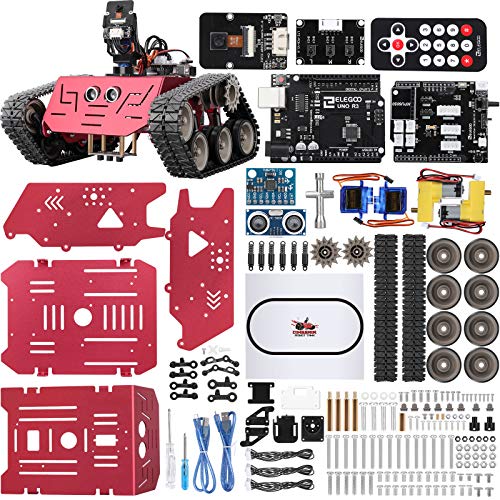
Built on Arduino foundations with open resources, this kit emphasizes DIY assembly and hands-on learning. The graphical programming features provide block functions to facilitate understanding of the car’s capabilities, while its diverse feature set stimulates creativity and problem solving. The Conqueror encourages learners to experiment with circuit design, motor control, and autonomous behaviors, making it a compelling choice for those who enjoy project-based STEM exploration.
ANNISOKA Robot Arm Kit

This robotics arm kit blends motors, PCB microcontroller boards, and wiring to offer a tangible introduction to circuits and mechanical control. The kit emphasizes 3D puzzle assembly alongside electrical engineering concepts, delivering a satisfying and educational build experience for older teens and adults. Note that some configurations require 6 AA batteries for operation. It is designed to cultivate hands-on understanding of how electronics drive mechanical motion and automation.
Thames & Kosmos Mega Cyborg Hand

Designed to operate without motors or batteries, this hydraulic system uses air pressure and the user’s own hand strength to flex fingers. Each finger joint is adjustable for precise movement, and the wearable hand demonstrates pneumatic principles in a compact, demonstrable form. This kit is well-suited for learners interested in fluid power, robotics mechanics, and user-interactive design, offering a tactile bridge to more complex hydraulic systems.
ACEBOTT Smart Robot Car Kit with ESP32
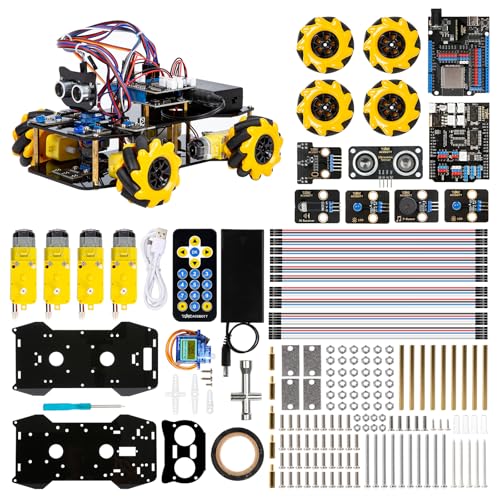
This kit centers on an ESP32 controller for programming and control, featuring a 3MP camera for real-time streaming. It includes 16 tutorials that guide users through assembly, coding, and system integration using Arduino and Scratch compatibility. The robust expandability—camera modules, robotic arms, and various expansion packs—supports diverse projects from image processing to autonomous navigation, making it suitable for serious hobbyists and aspiring engineers seeking scalable challenges.
Demkia 4-in-1 Rechargeable RC Kit

Demkia’s 4-in-1 kit offers multiple forms — WALL robot, Scorpion Crane, Engineering Grader, and Scout Tank — within a single building set. The kit emphasizes articulated movement, variable gear linkage, and a combination of remote and app control, delivering a rich platform for exploring robotics, STEM coding, and mechanical design. The included 2.4GHz remote and Bluetooth app control provide flexible user experiences for solo tinkering or collaborative learning sessions.
Buying Guide
Key purchase considerations when selecting stem robotics kits for adults and older teens:
- Skill level and learning path: Choose kits with scalable complexity, clear tutorials, and project progression to match your current proficiency and growth goals.
- Platform and compatibility: Arduino- and ESP32-based kits offer broad community support and extensibility; confirm compatibility with Scratch, Python, or C++ as desired.
- Expandability: If ongoing projects appeal, prioritize kits with additional modules (cameras, arms, sensors) or expand-on-demand packs rather than rigid single-use sets.
- Hardware quality and reliability: Durable components, robust connectors, and well-documented schematics help minimize troubleshooting frustration.
- Learning outcomes: Look for kits emphasizing electronics fundamentals, programming concepts, and mechanical design rather than purely toy-like features.
- Support and resources: Access to tutorials, community forums, and official documentation accelerates skill acquisition and troubleshooting.
- Time investment and goals: Some kits are quick builds; others demand longer, multi-session projects. Align with your schedule and ambition.
- Budget considerations: Entry-level kits are affordable entry points; feature-rich kits with cameras and multiple modules may present higher upfront costs but offer long-term value.
In choosing the right kit, assess whether you prefer beginner-friendly tutorials with broad community support or a more advanced system that offers extensive expandability and professional-grade experimentation. For adults, kits that blend hands-on mechanics with programmable control—such as ESP32-based robots, hydraulic hands, and Arduino-enabled cars—tend to provide the richest learning experience while supporting creative, long-term projects.