In this guide
Finding the right toys for a one-year-old means balancing safety, simplicity, and sensory engagement. The following selections—carefully chosen for early development—cover push-and-go toys, interactive learning seats, busy boards, early literacy, and musical play. Each option emphasizes rounded edges, non-toxic materials, and age-appropriate challenges to support motor skills, language development, and curiosity.
| Product | Brand | Why It Stands Out | Link |
|---|---|---|---|
| iPlay, iLearn Press to Go Car Toys | iPlay, iLearn | Press-and-go action, bright colors, safe ABS design | https://www.amazon.com/dp/B0BTBV51KY?tag=mytoysna-20 |
| Laugh & Learn Smart Stages Chair | Fisher-Price | Smart stages with lights, songs, and evolving learning levels | https://www.amazon.com/dp/B0CKWMH8D8?tag=mytoysna-20 |
| Iabedi Busy Board Plus | Iabedi | Montessori-inspired, multiple switches and LEDs for exploration | https://www.amazon.com/dp/B0CT2WSCKP?tag=mytoysna-20 |
| LeapFrog 100 Words Book | LeapFrog | 100+ words, interactive pages, song and word-learning | https://www.amazon.com/dp/B07B6ZN7P8?tag=mytoysna-20 |
| FOKI Toddler Floor Piano Mat | Foki | 61 sounds, animals, melodies; encourages movement and rhythm | https://www.amazon.com/dp/B0FJSHWGSP?tag=mytoysna-20 |
iPlay, iLearn Press to Go Car Toys for Toddlers

The Press & Go car toy combines safety and simplicity, designed with rounded edges and smooth surfaces ideal for babies exploring through touch and motion. Constructed from high-quality ABS materials, the toy contains no small parts that could pose choking hazards, aligning with early safety standards for 6- to 18-month-olds. To play, little ones press the car’s head and watch it glide forward—no batteries required. Its bright colors and cartoon-style design help stimulate visual and cognitive development, making it a practical pick for supervised playtime and independent exploration alike.
Features emphasize safe construction, a battery-free motion mechanism, and engaging visuals. The toy’s friction-based propulsion minimizes noise and complexity while encouraging cause-and-effect learning. Parents can use the car to practice hand-eye coordination, reach and grasp, and early movement skills as babies push the toy across a play surface. The simple interaction supports attention building and sensory processing, which are foundational for later learning milestones.
Fisher-Price Laugh & Learn Smart Stages Chair

This electronic learning chair offers engaging lights, sounds, and activities that captivate infants ages 1 and up. With over 120 songs, sounds, and phrases, it adapts as a child grows, using Smart Stages to introduce colors, shapes, numbers, counting, and opposites. The interactive seat changes behavior based on whether the toddler sits or stands, effectively reinforcing language and cognitive development in the early years. The chair’s design supports independent play while providing guided prompts for caregivers who want structured learning moments during playtime.
Its multi-sensory approach—auditory, visual, and tactile—helps toddlers connect words to meanings, supporting early vocabulary growth. The varying levels keep older infants engaged as they master new concepts, while the compact form makes it suitable for small spaces. Caregivers can integrate this seat into daily routines, using it as a transition toy for snack times or read-aloud sessions that pair with the music and lights for a cohesive learning experience.
Iabedi Busy Board Plus

The Busy Board Plus is a Montessori-inspired toy designed to stimulate fine motor skills and problem-solving. It features multiple switches and LED lights across ten distinct sections, with a master switch to power off all lights to save energy. The board supports color and shape recognition and offers hands-on exploration that fosters cognitive development. Supplied with two AAA batteries, it’s portable enough for car rides and travel, and its compact size makes it easy to integrate into play areas or naptime corners. The design emphasizes safe materials and approachable challenges that are appropriate for 12- to 36-month-olds.
Parents can leverage the variety of activities to encourage sequencing, cause-and-effect understanding, and hand-eye coordination. The busy nature of the toy also supports short attention spans typical of this age, providing brief, repeatable tasks that build confidence. The sturdy construction is designed for repeated use and rough handling common in toddler play, while the colorful LEDs attract visual attention and curiosity.
LeapFrog Learning Friends 100 Words Book
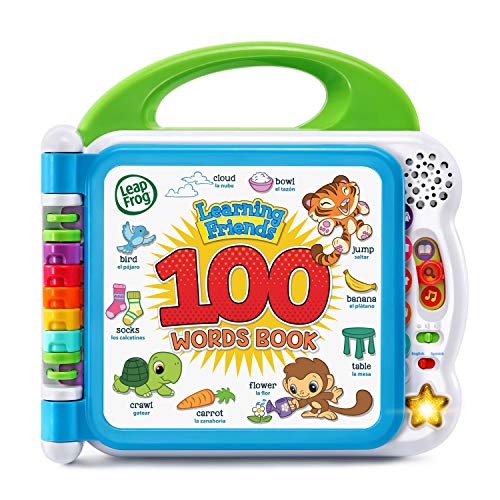
The LeapFrog 100 Words Book introduces essential vocabulary through interactive pages featuring learning friends Turtle, Tiger, and Monkey. The toy provides more than 100 words across diverse categories like pets, colors, meals, and outdoor activities. Touching the words triggers sound effects, the Learning Friends theme song, and a light-up star button for extra engagement. The book-style format encourages early literacy, comprehension, and word association, while the on-device audio reinforces correct pronunciation and pronunciation cues for toddlers beginning to speak. Ideal for quiet moments or shared reading times, this toy blends language development with playful storytelling.
Its age-appropriate content supports convergent and divergent thinking as children relate objects to words. The compact, portable format makes it suitable for travel and quiet play in restaurants or cars. Although designed for screen-free learning, it complements other educational toys by building a foundation in vocabulary, listening skills, and memory associations through repetitive exposure and positive reinforcement.
FOKI Toddler Floor Piano Mat

This floor piano mat creates an active, music-filled playtime that promotes movement and rhythm. With 61 built-in sounds, including 10 animals and 34 nursery melodies, the mat offers multiple modes and a record-and-playback function for up to 150 notes. Designed for ages 1 to 5, it encourages crawling, walking, and dancing while teaching early musical concepts, color recognition, and animal names. The bright visuals and soft lighting help maintain attention and support sensory development. The mat’s large footprint fosters gross motor skills as toddlers press keys with feet or hands, creating a dynamic learning environment.
Educators and caregivers can use it to pair physical activity with auditory learning, reinforcing language through sound and movement. While it’s a lively centerpiece for playrooms, it also serves as a teaching aid for rhythm and tempo, enabling parents to introduce basic beat concepts in a playful setting without screens or batteries in use. The design prioritizes safety, but supervision is recommended during active play to prevent slips or minor injuries on hard floors.
Buying Guide: Key Purchase Considerations And Comparisons
- Safety first: Look for rounded edges, non-toxic materials, and no small detachable parts. All items listed here emphasize safety designed for 12- to 36-month-olds.
- Developmental fit: For motor skills, choose push-and-go toys or balance bikes. For language, select books and interactive audio toys. For sensory play, prefer busy boards and musical mats.
- Age-appropriateness: Ensure toy instructions align with a 12–24 month or 1–3 year window, as recommended by manufacturers. Toys that scale with stages, like smart-stages chairs, can grow with the child.
- Maintenance and durability: Look for sturdy construction suitable for frequent use and easy cleaning, especially for toys used during meals or in car rides.
- Portability and space: If space is limited, prefer compact Busy Boards or foldable mats. For travel, consider lightweight toys with simple setups and minimal parts.
- Learning approach: A mix of tactile, auditory, and visual stimuli helps balance sensory processing with cognitive development. Combining a single toy with complementary activities can maximize learning outcomes.
- Battery considerations: Battery-free designs simplify safety and maintenance, though some electronic toys with lights and sounds offer richer language and reaction cues when appropriate.
- Caregiver involvement: Toys should invite guided interaction—reading, singing, or describing actions—to reinforce language and social development.
- Value and longevity: Investments in versatile toys that adapt to growth (from exploratory to guided learning) often yield better long-term engagement.
- Consider rotating toys to maintain novelty and encourage new skills over time.
- Pair toys with related books or songs to deepen learning connections.
- Monitor for signs of wear or damage and replace any items with loose parts or sharp edges.